BENEDETTO FELLIN
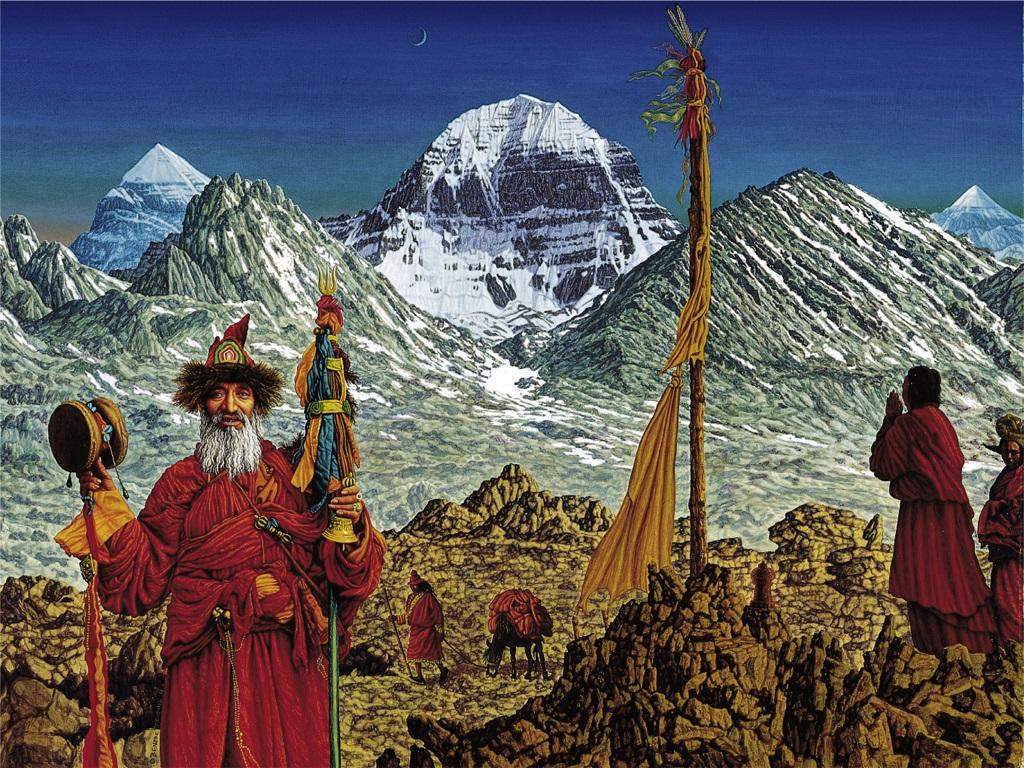
Infeld Haus der Kultur in Halbturn is dedicating a solo exhibition to Benedetto Fellin on the occasion of his 70th birthday. The works produced over the past fifty years represent a special form of figurative painting. Viewers encounter seemingly surreal worlds in which very real people, cultures, religions and landscapes stand in perceptible relationships to one another.
With an Old Master painting technique, Benedetto Fellin fuses Buddhist thought with a European mode of expression. The artist appears as a seeker between two worlds. Although raised and rooted in the intellectual tradition of Central Europe, he felt an early and profound longing for the mysticism of the Far East.
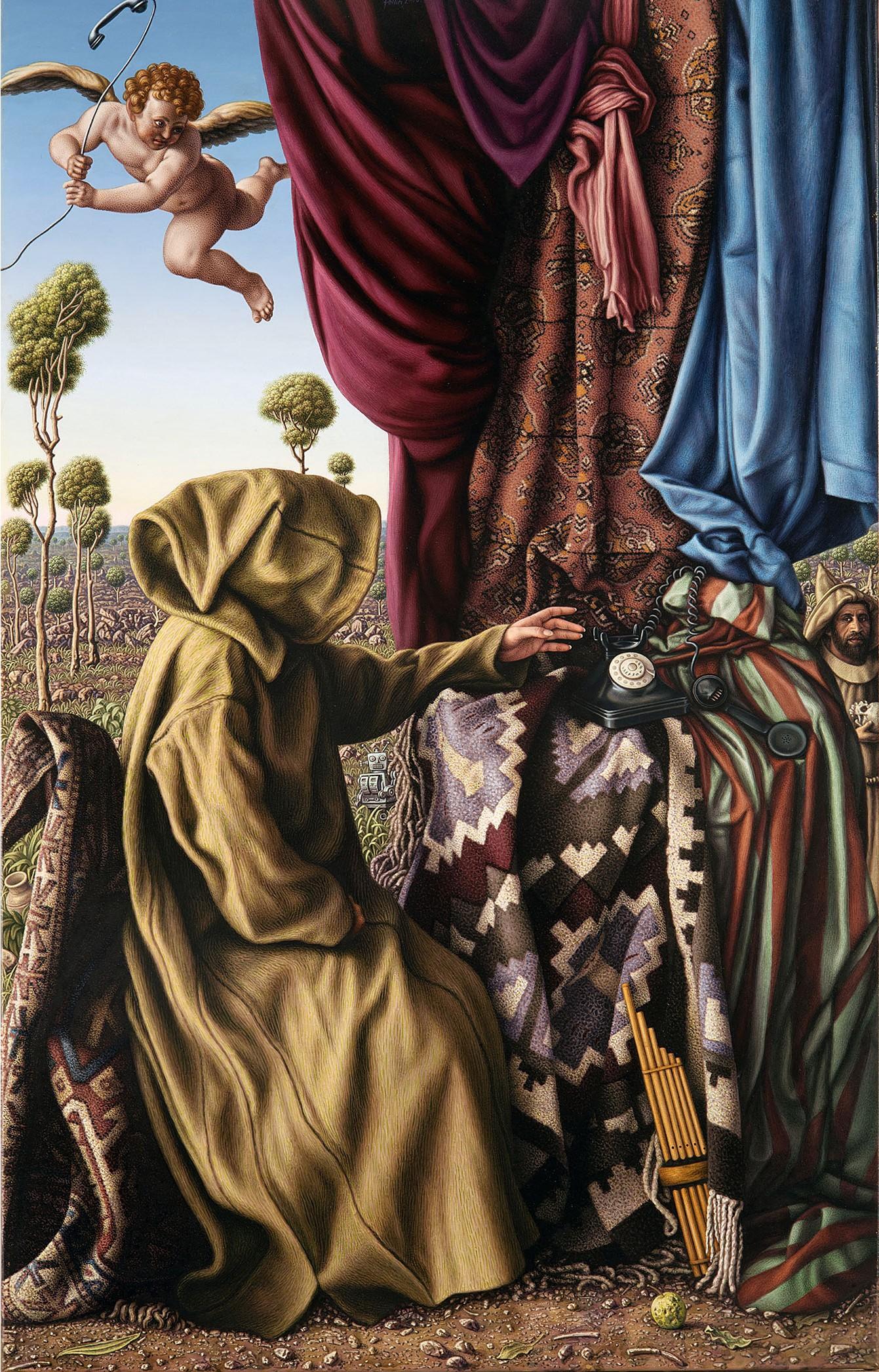
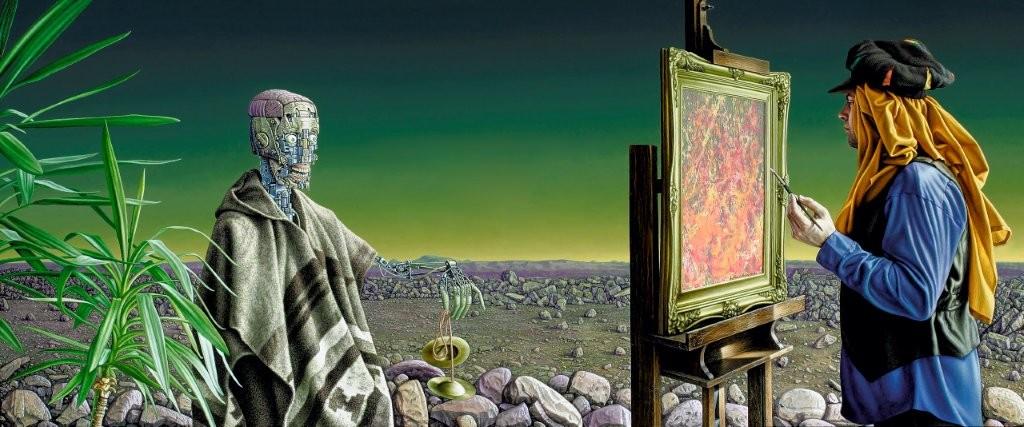
With precision and meticulous accuracy, Benedetto Fellin unites the representational with the mystical, visualising the contemplative. His pictorial language is enigmatic. In his multilayered and multifaceted compositions, beauty and perfection remain central: human beings shaped by their cultures and religions; the sensual aesthetics of drapery; the sublime beauty of the Himalayan region.
The tension between the visible and the invisible is also visualised by Benedetto Fellin through veiling: a particularly topical social issue in today’s Western cultural sphere, which is confronted with the veiling of women.
Profound and magical in meaning, Fellin links the past with the present and the future. His yearning for harmony often stands in contrast to the destructive tendencies of the technological age and leads to a quiet form of protest, which is reflected in the works in which robots and bitcoins also appear.
“My paintings are often inner journeys. I have realised that my true home is within me,” writes Benedetto Fellin. For him, art, life and being form a unity.
His works invite self-reflection; viewers invent their own stories inspired by his picto-rial creations. Fellin reminds us how important a mindful life toward all beings, and mindfulness in the present moment, truly is.
Peter Infeld (1942-2009) wrote about Benedetto Fellin: “Interpreter of dreams, wan-dering through endless mountains, wide plains, entwining concealments und cover-ings.
Who knows how his inner self inclines the paintbrush, selects the colour, from whence comes the inspiration that floods his being when he paints.
This path, from the world of Buddhist ideas to his own self-defined religiousness, fas-cinated me. His readiness to adapt the techniques of the Old Masters and use them in hitherto unknown dimensions of creative expression has always excited me and is also a challenge to the viewer to open their eyes, their spirit and their physical self.”
Biography Benedetto Fellin
Benedetto Fellin was born in 1956 in Merano, South Tyrol, and studied at the Vienna Academy of Fine Arts under Prof. Rudolf Hausner.
He received public distinctions such as the Hausner Sponsorship Prize in 1979, the Academy Friends Prize in 1983, the Theodor Körner Prize in 1984, and the ART Award of the Professional Association of Visual Artists of Austria in 2025.
Study trips took Fellin to Asia, Africa and Central America and influenced the themes of his painting. His works have been shown in Vienna, Innsbruck, Kiel, Munich, Tokyo, Bangkok and Mexico, among other places. The support of important private collectors, such as the Viennese string manufacturers Margaretha and Peter Infeld, promoted his development.
Works by Benedetto Fellin are held, in addition to numerous private collections, in the Austrian Gallery at Belvedere Palace, the Ferdinandeum in Innsbruck and the Reinhold Messner Museum (MMM) in South Tyrol.
The artist lives and works in Vienna and Hungary.
The Infeld collection
Peter Infeld (1942-2009) and his mother Margaretha Infeld (1904-1994) began to collect art in the mid-1960s.
The Vienna School of Fantastic Realism, naive art from Croatia, Pop Art, Buddhist meditation paintings from Tibet (so-called "Thangkas") and Art Brut are the main focus of the Infeld collection.
In order to make the works accessible to a broader public, patron of arts Peter Infeld, has built representative cultural centers in Halbturn in Burgenland and in the idyllic village of Dobrinj on the Croatian island of Krk. In total, more than 120 exhibitions were held free of charge at both locations.
Press Photos